
What a Trained Brand Team Notices When It Evaluates a Fragrance Supplier
A brand team that has been through structured scent training evaluates a fragrance supplier differently, because it can describe what it smells and separate a preference from a defect. That single ability changes the questions asked in a first meeting, the way samples are compared, and the evidence the team is willing to accept before it signs anything. For a direct-to-consumer brand, where the product itself is the only proof of quality, the difference usually shows up in the first sample round rather than in the first year of selling.
Key takeaways
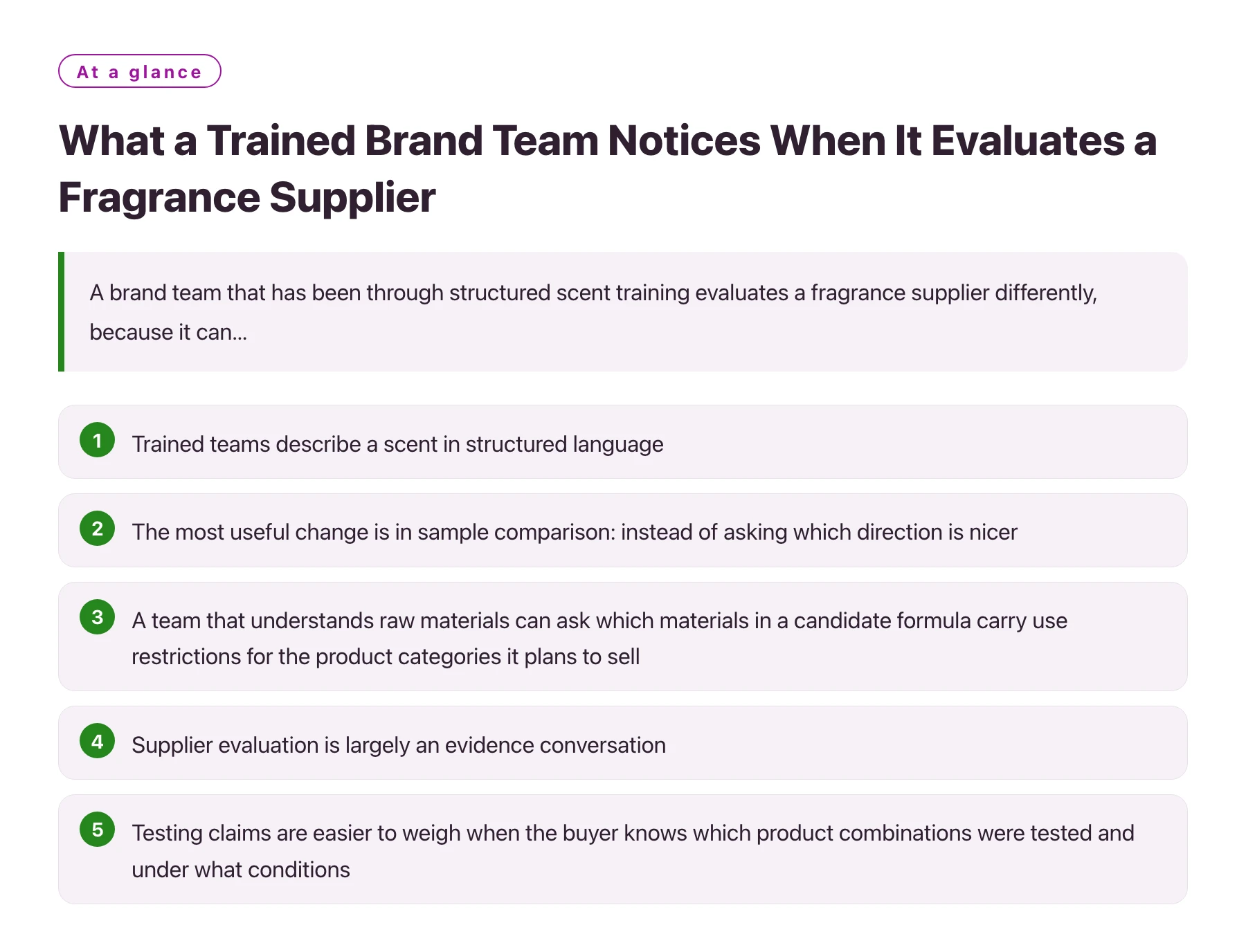
- Trained teams describe a scent in structured language, so an answer from a supplier can be checked against the brief instead of argued about as a matter of taste.
- The most useful change is in sample comparison: instead of asking which direction is nicer, a trained team scores every direction against the same written criteria.
- A team that understands raw materials can ask which materials in a candidate formula carry use restrictions for the product categories it plans to sell, and can read the answer it gets [1].
- Supplier evaluation is largely an evidence conversation, where batch records, retained references, test reports and an audit trail outweigh a polished showroom or a well-rehearsed presentation.
- Testing claims are easier to weigh when the buyer knows which product combinations were tested and under what conditions, because that is ordinary laboratory work rather than a favour [2].
A direct-to-consumer brand buys fragrance the way it buys everything else: with its own judgement and no merchandising gatekeeper standing between the decision and the customer. There is no retail buyer to insist on a test report, no distributor to absorb a bad batch, and no category manager to notice that the second production run smells thinner than the first. All of that filtering has to happen inside the brand, which is why scent training pays for itself in the evaluation stage before it pays for itself anywhere else.
Training is not about becoming a perfumer. It is about acquiring a shared vocabulary for the handful of judgements a brand team makes repeatedly: whether a sample answers the brief, whether two suppliers are describing the same product, whether a defect is a defect or a variation, and whether the paperwork behind a claim is complete. Once those judgements have words attached, they can be written down, delegated and tested.
What follows is the shape of a supplier evaluation run by a team that has had that training, written for a brand selling through its own store and its own channels.
Why the first meeting sounds different
A supplier calibrates to the vocabulary of the buyer in front of it. Asked whether a fragrance is good, a sales contact answers in adjectives. Asked whether the top note is sharper than the brief and whether the drydown loses the woody base after twenty minutes, the same contact either answers with specifics or reveals that nobody in the room can. Both outcomes are useful, and only the second kind of question produces them.
For a direct-to-consumer brand this matters more than it does for a wholesaler, because the team is the final filter. The brief is written internally, the samples are judged internally, and the customer's reaction arrives directly as a review or a return rather than as a quiet order reduction. A team that cannot articulate why a sample is wrong will approve it anyway and discover the problem in the review section.
From preference to criteria
Untrained evaluation collapses into ranking. The team smells four directions, agrees that number two is pleasant, and moves on, which means the brief that produced the other three is never diagnosed. Trained evaluation replaces the ranking with a small scorecard: does the opening match the reference, does the heart carry the declared theme, does the base hold for the length the product needs, and does the whole thing still read as the brand.
A scorecard of that kind is cheap to build and hard to argue with. It also survives staff changes, which is the point. When the person who chose the first range leaves, the criteria stay behind and the next hire can apply them.
Reading a safety answer
The question that most clearly separates a trained buyer from an untrained one is about material restrictions. Fragrance materials carry use limits that depend on the product category, so a formula that is comfortable in a fine fragrance may need adjustment in a body lotion or a home spray. A buyer who has been taught this asks which materials in the candidate are limited and how much headroom remains, and can tell whether the reply is an actual assessment or a reassurance [1].
The same applies to testing. Compatibility and stability work is commissioned as a defined package, and the package is only meaningful when it names the combinations being tested. Knowing that turns a vague promise into a specific question: which bases, which packaging, which conditions, and who signs the report [2].
The evaluation sequence a trained team runs in order
- Screen on scope before scentEstablish which of development, compounding, filling, packaging and decoration the supplier performs itself, and which parts are subcontracted, because the answer defines where accountability sits.
- Send one brief, not a wish listA single written brief with a reference, a target market and the products the scent will live in is the fastest way to see how a supplier reads instructions.
- Score samples against the criteriaEvery direction is scored on the same line items so that the comparison is a record rather than a memory of a pleasant afternoon.
- Ask for the documentation earlyRequesting a sample of the paperwork, not the whole file, at evaluation stage shows whether documents exist as a system or are assembled on request.
- Test one claim independentlyPick a single technical claim, such as retention of a reference from an approved batch, and ask how it is verified; a specific procedure is a much better signal than a certificate list.
- Compare the answers, not the brochuresTwo suppliers answering the same six questions in writing can be compared in an afternoon; two brochures cannot be compared at all.
What the trained team still cannot do
It is worth being honest about the limits. A trained brand team can evaluate a fragrance and question a process, but it cannot formulate, and it should not try. The value of the training is in asking better questions and recognising a weak answer, not in replacing a perfumer or a quality function.
The second limit is time. A scorecard only works if it is filled in during the sample round, while the samples are still on the table and the references are still to hand. Teams that leave it until the end of a quarter end up reconstructing judgements from notes, which is exactly the situation training is meant to avoid.
That division of labour is itself a question worth putting to a supplier directly: which decisions belong to the brand and which belong to the factory. A manufacturer that answers clearly, and that can point to its own development and quality functions rather than to a partner network, is easier to work with across a multi-year range. It is the kind of answer a brand should expect when it looks at a supplier such as Xuelei Fragrance and asks it the same six questions it asked everyone else.
If a brand can only train on one thing, train on the sample round. It is the moment where the brief, the supplier and the budget all meet, and it is the stage where a team that can describe what it smells will save the most money. A partner that expects to be evaluated that way will usually make the process easier: it will send structured information with the samples, answer questions about materials and testing in writing, and treat the comparison as a normal part of the work rather than an interrogation. That posture is itself one of the signals worth scoring, and it is the one a direct-to-consumer brand feels fastest when it is dealing with how to evaluate a custom fragrance manufacturer for the first time, or when it starts looking for a place to learn perfumery to build the capability internally. A brand that invests in the vocabulary ends up choosing between suppliers on evidence, and that is a much shorter conversation than choosing between them on charm and then hoping. Teams that keep the scorecard for two sample rounds tend to find that the second round is cheaper, faster and far less emotional than the first.
Sources
- IFRA Standards Library (International Fragrance Association) —— The IFRA Standards Library lists the restrictions the fragrance industry applies to individual fragrance ingredients, based on safety assessments; it is the reference point for compliant fragrance formulation.
- Cosmetics & Toiletries —— A technical magazine for cosmetic formulators, covering ingredients, formulation science and testing methods.
Frequently asked questions
Do we need perfumery training before we can evaluate a fragrance supplier?
No, but without it the evaluation tends to rely on overall impression, which is hard to compare across suppliers and impossible to hand over to a new team member. A short structured course or an internal programme that teaches vocabulary, concentration, note structure and material restrictions is usually enough to make the sample round much more productive.
What is the single most useful question to ask a fragrance supplier?
Ask what they do in-house and where the handovers are. The answer defines who is accountable for the scent, the fill, the bottle and the decoration, and it exposes the points where a project usually loses time. A supplier that can draw that map quickly is usually one that has run the process many times.
How many suppliers should a direct-to-consumer brand evaluate at once?
Two or three is usually workable, because each one needs the same brief and the same scoring. More than that multiplies sample rounds and meeting time without improving the decision, and the comparison becomes a memory test rather than a record.
Should we ask for certificates or for test reports?
Both, but they answer different questions. Certificates describe a management system that has been audited; test reports describe what happened to a specific formula, batch or package. A brand selling directly to consumers needs the second kind as much as the first, and asking for a sample report at evaluation stage is a quick way to find out whether they exist.
How does training change the way we write the brief?
It makes the brief testable. Instead of describing a mood, a trained team can name a reference, a target concentration, the products the scent must work in and the performance it has to hold. Suppliers can answer a testable brief with a specific proposal, and the samples that come back can be judged against what was actually asked for.